
Papago Vans
Target audience · Internal

Prepared for ownership · Papago Vans

Three buyers.
Three different constraints.

The temptation is to split this audience by age, because the data invites it: Class B ownership is barbell-shaped, roughly half under 35 and half over 55, with almost nobody in the middle. But age is not what makes these two people behave differently. One is constrained by what they want, one by when they need it, and one by a problem nobody else will solve. That distinction decides the product they buy, the promise that moves them, and the sentence that loses them.

Why this matters more than a demographic split. A constraint tells you what to say. Knowing someone is 64 does not. The Specifier will wait a year for the right van and walk away over a tone of voice. The Departure Date will accept somebody else's floor plan without blinking and walk away over a vague answer about timing. Those are opposite sales conversations, and Papago currently has one product line and one script for both. That is the case for Papago Collection stated in terms of people rather than bay-months.
Avatar 01
Constrained by specification

The Specifiers

They know exactly what they want, and they have the time to get it right.

Illustration of The Specifiers: They know exactly what they want, and they have the time to get it right.
Illustrative. Not a real customer.
Age
Late fifties to early seventies
Situation
Kids launched. First real window of unstructured time in thirty years.
Money
Pays cash or close to it. 45% of all RV purchases are cash.
Trigger
A retirement date, a house sale, a business sold, a health scare that moved the timetable up.
Owned before
Often a bigger RV they have deliberately rejected, or nothing at all.
Timeline
Flexible. A wait is annoying, not disqualifying.

What they are actually buying

Control. The bed on the right side because of a bad shoulder. The galley height because one of them is tall. The dog's spot. They are not buying features, they are buying the absence of compromise.

“We have waited a long time for this. We are not going to settle on the one thing we actually care about.”

What they are afraid of, in order

  • Will the shop still existHighest. They are handing over a large share of a finite retirement pot and cannot earn it back.
  • Will it actually be what we asked forHigh. Specific requests being quietly value-engineered out is the nightmare.
  • Who fixes it in year threeHigh. They intend to keep it a long time and will not enjoy a warranty argument.
  • Will it take too longLow. They have the time. This is the objection they do not have.
The promise that lands
Nothing gets changed without you saying so, and we are here in year five.
Fits: Papago Custom, or the top of the Papago Collection ladder with real choices inside it.
Creative territories: Come Look, The Deposit, Twenty-One Days

What loses the deal

Being made to feel like an inconvenience for asking. This buyer walks over tone, not price.

Avatar 02
Constrained by the calendar

The Departure Date

They have a date in mind, and the van has to exist by then.
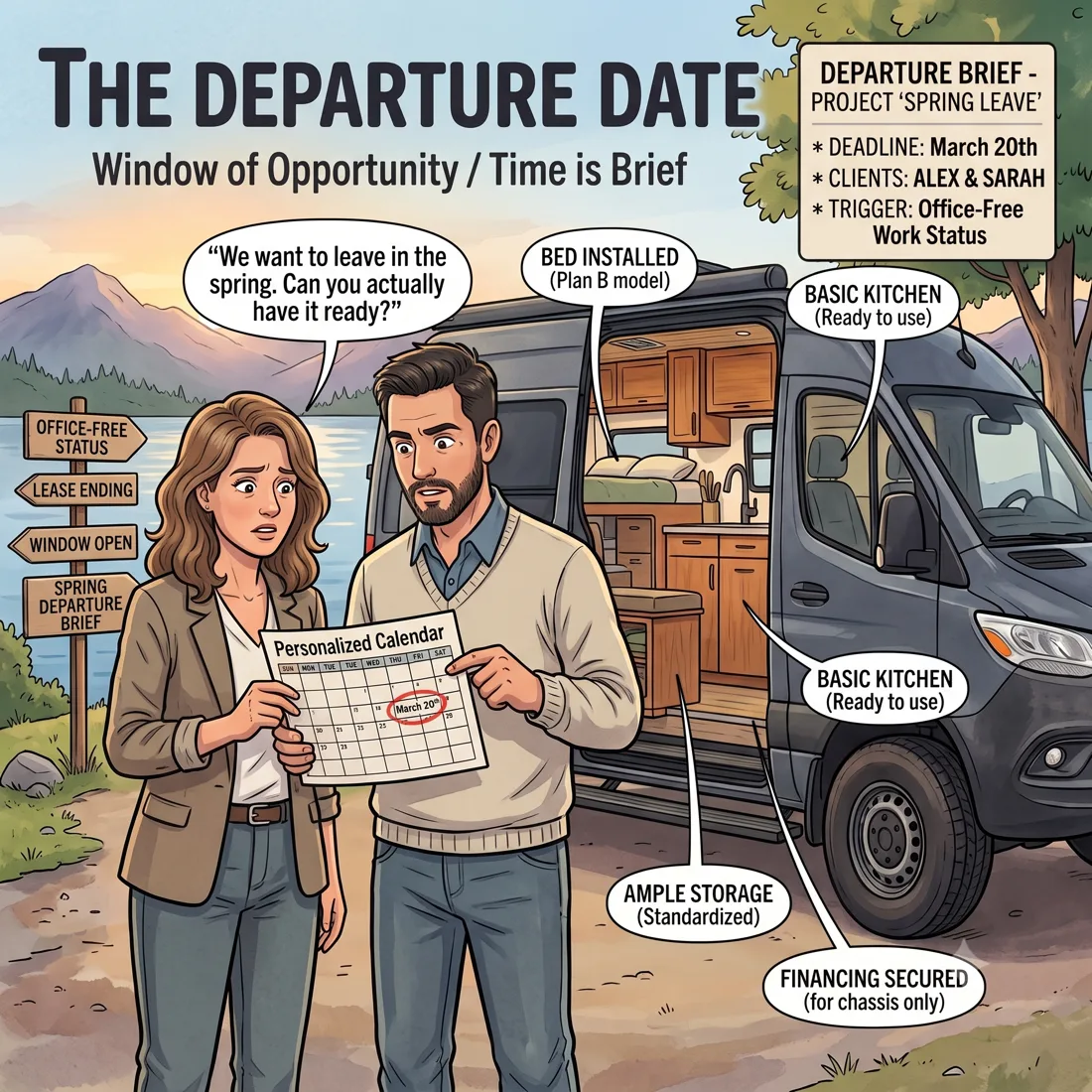
Illustration of The Departure Date: They have a date in mind, and the van has to exist by then.
Illustrative. Not a real customer.
Age
Early thirties to late forties
Situation
Work went permanently location-free, or a window opened that will close again.
Money
Has it, but often needs financing. Lenders underwrite the chassis and ignore the conversion, which is a live problem.
Trigger
A job that stopped requiring an office, a lease ending, a sabbatical, a decision to go now rather than at sixty.
Owned before
Maybe a rented van, maybe a first DIY build they have outgrown.
Timeline
The whole point. Ninety days is not a preference, it is the brief.

What they are actually buying

A departure date. They want a van that works, not a van that is theirs alone. Show them three good plans and they will pick one in an afternoon, because choosing is not the part they enjoy.

“We want to leave in the spring. Can you actually have it ready?”

What they are afraid of, in order

  • Will it be ready when you saidHighest. A missed date does not cost them money, it costs them the trip.
  • Will the shop still existHigh. Same fear, same six documented failures, but felt as lost time as much as lost money.
  • Can I finance the conversionHigh, and usually unspoken. This is the objection that silently disqualifies them.
  • Can I have it exactly my wayLow. They will trade customisation for certainty, and are relieved to be told what works.
The promise that lands
Twelve weeks from contract to keys, or we pay you.
Fits: Papago Collection. This avatar is the reason the second line should exist.
Creative territories: The Queue, Payload, Fly In Drive Home

What loses the deal

A vague answer about timing. One “we should be able to” and they are calling the next shop.

Avatar 03
Constrained by a problem nobody else will solve

The Problem Solver

The van has to do one specific thing, and no factory floor plan does it.
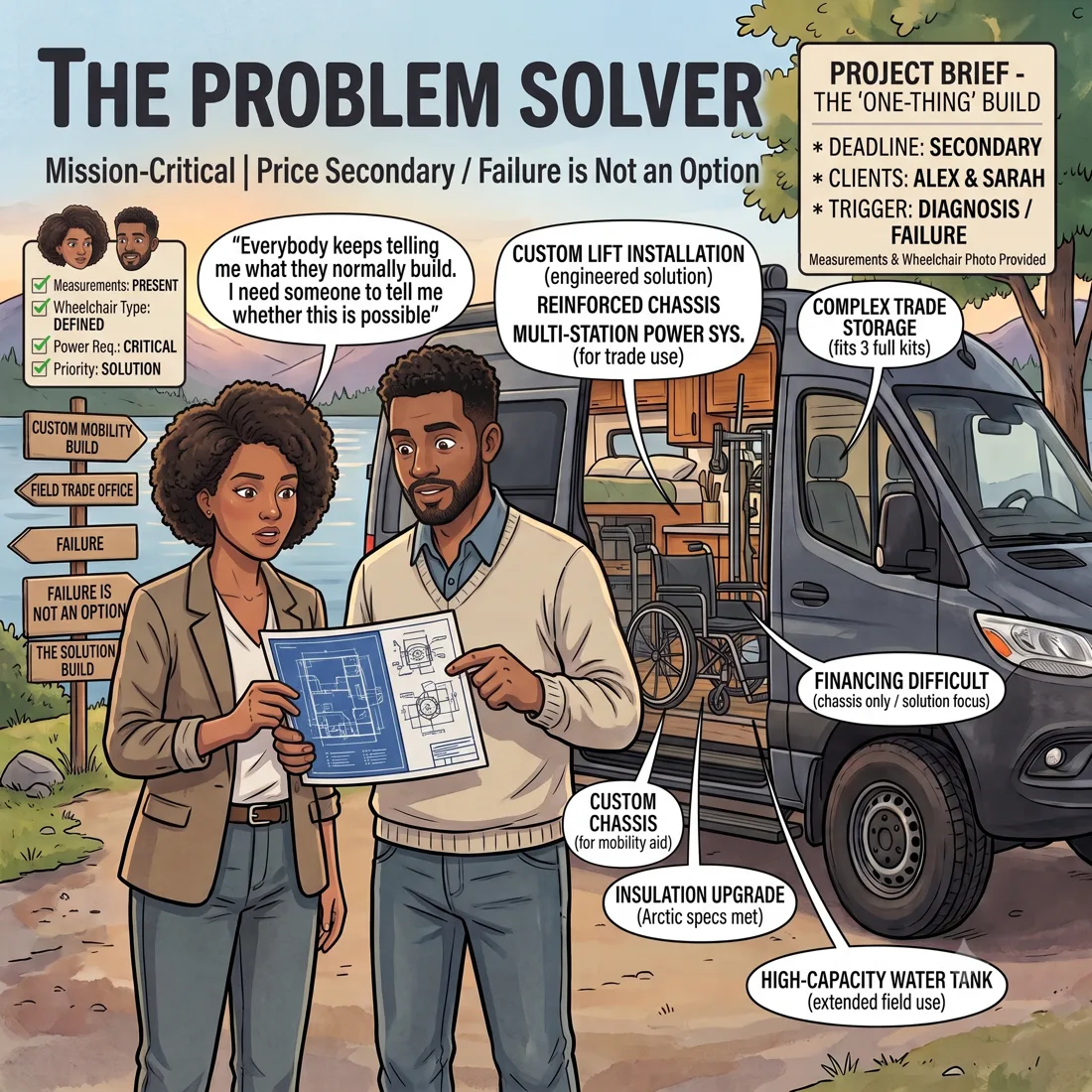
Illustration of The Problem Solver: The van has to do one specific thing, and no factory floor plan does it.
Illustrative. Not a real customer.
Age
Any. This one genuinely cuts across the barbell.
Situation
A trade that travels, a mobility need, three large dogs, a sport with awkward gear, a business run out of the back.
Money
Will spend what the problem costs. Price sensitivity is low because the alternative is nothing.
Trigger
Usually a failure. A rented van that did not work, a factory build they had to modify, a diagnosis, a business that outgrew a truck.
Owned before
Often yes, and it is why they are here. They know precisely what was wrong with it.
Timeline
Secondary. They will wait, because waiting beats a van that does not work.

What they are actually buying

A solution. They are not comparing us to other builders on finish or price, they are comparing us to the problem continuing. They arrive with measurements, a photograph of a wheelchair, or a list of what the last van got wrong.

“Everybody keeps telling me what they normally build. I need somebody to tell me whether this is possible.”

What they are afraid of, in order

  • Will you actually engineer it, or just agreeHighest. They have been told yes before by a shop that meant maybe.
  • Will it be safe and legalHigh, and often the reason they left a cheaper builder. Payload, load paths, certification.
  • Will the shop still existHigh, same as everyone.
  • Will it be on timeLowest of the three avatars. They have already accepted this takes as long as it takes.
The promise that lands
Tell us the problem before you tell us the van. If it cannot be done safely we will say so.
Fits: Papago Custom, and only Papago Custom. This is the reason the flagship has to survive.
Creative territories: Payload, Come Look

What loses the deal

Being sold a standard layout with modifications bolted on. They can tell, and it confirms every fear they arrived with.

One will wait a year for the right van. The other will take somebody else's floor plan to leave in April. Selling them the same thing wastes both.

The whole argument

Side by side

Where they diverge

The rows that matter operationally. Read the last two first, because they are the ones a salesperson can act on this week.

The SpecifiersThe Departure DateThe Problem Solver
What constrains themTheir requirementsTheir calendarA problem with no off-the-shelf answer
Product linePapago CustomPapago CollectionPapago Custom, exclusively
The promise that landsNothing changes without your say-soTwelve weeks, or we pay youWe will tell you if it cannot be done
Price band they land in$108,595 to $127,395 conversion, and up$86,795 to $108,595 conversionWhatever the problem costs
Time sensitivityLow. Will wait for the right thing.Absolute. The date is the brief.Lowest. Waiting beats a van that fails.
Customisation appetiteHigh, and it is the reason they chose usLow, and they are glad of itTotal, and non-negotiable
Financing neededRarely. Often cash.Usually, and it is a real obstacleVaries. Sometimes an insurer or a business pays.
Biggest objectionWill you still exist, and will it be what I asked forWill it be ready when you saidCan you actually engineer this
What wins themBeing taken seriously and a shop they can walk intoA date in writing with money behind itAn engineer who says no to the wrong idea
What loses themFeeling handledA vague answer about timingA standard layout with modifications bolted on

Common ground

What both of them share

Four things are true of every buyer at this price, and the creative has to carry them regardless of which avatar it is aimed at.

True of both

  • It is an emotional purchase and they know itA van like this is used a median of 21 days a year. Both avatars have quietly done that arithmetic and decided to buy anyway. Pretending it is a rational investment loses the room.
  • Deposit risk frightens themSix shops have taken customer money and failed mid-build. The Specifier fears losing capital they cannot replace. The Departure Date fears losing the season. Same fact, two different wounds.
  • They trust another owner over usPeer proof outranked every marketing claim in the research. Both will go looking for somebody with the same van from the same shop before they call.
  • Most of them are on the East CoastWhich means both are already prepared to fly to Arizona, and neither has a good local alternative.

Why not more than three

  • Sport is a lens, not a personSkiers, climbers and mountain bikers show up all over this research, but a 62-year-old skier is a Specifier who skis and a 34-year-old biker is a Departure Date who bikes. The constraint does not change, only the gear does. Put the sport in the creative, not in the segmentation.
  • Remote work is a trigger, not an avatarIt is what moved the Departure Date from someday to this spring. It explains timing rather than describing a different buyer.
  • Families are not a separate segment here59% of Class B owners have no children at home. The van is small. Families in this category are usually buying a Class C and we should let them.
  • More avatars means a thinner storyThree constraints produce three sales conversations, which a team can hold in its head. Six produce none, and the Andromeda work already handles variety through creative rather than segmentation.

Who is not a customer

  • Anyone comparing on cost per nightIf the spreadsheet is out, this is the wrong product and the wrong conversation. Say so early rather than discovering it in month four.
  • The full-time van-lifer at $39,000A real buyer, just not ours, and there is a shop fifteen minutes away built for them. Chasing that price is the one path that loses.
  • Someone who wants living spaceThey want a fifth wheel and do not know it yet. Class B trades volume for access, and the buyer who wants room will be unhappy whatever we build.
  • Anyone who cannot fund the conversionLenders underwrite the chassis and ignore the build. Until there is a financing answer this is a disqualification, not an objection, and it is worth finding out on the first call.

Honesty

What is evidence and what is inference

Sourced: the barbell age split, cash purchase rates, children at home, remote-work share, the 21-day usage figure, the documented shop failures, the financing constraint and the East Coast concentration all come from published research or Papago's own sales pattern, and are cited in the Market Research document. Inferred: the three constraints themselves, the personalities, the quotes, the ranked fears and the price bands each avatar lands in. The Problem Solver in particular is drawn from the concept document's own language about a trade, a disability, a dog or a business, rather than from survey data. Those are reasoned from the evidence rather than measured, and no published research exists on buyers of $100,000+ custom conversions specifically. The fastest way to test all of it is to ask the people who already bought. The Buyer Study is the project that does it: nine weeks, our own records plus twelve interviews, and it replaces every inferred figure on this page with a measured one. Until then, treat the constraints as a working structure and the ages as a guess.